U.S. Army Motorcycle Corps at Fort Brown
In May of 1918, photographer Robert Runyon documented a U.S. Army motorcycle detachment at Fort Brown in Brownsville, Texas. The post sat on the southern border at the mouth of the Rio Grande, and the photographs show soldiers with Harley-Davidson J-model motorcycles, sidecars, and armored gun carriages during a period when the Army was still learning what motorcycles could do in military service.
These May 1918 Runyon photographs capture a very specific moment: World War I was underway overseas, the Mexican border crisis was still fresh in Army planning, and cavalry posts like Fort Brown were testing motorcycles for dispatch riding, reconnaissance, patrol support, and mobile machine-gun work. The images show the machines, the sidecar equipment, and the soldiers at a border post where the Army was still working out how motorcycles fit into military service.

Fort Brown and the Border Crisis
Fort Brown was located at Brownsville, Texas, directly on the Rio Grande opposite Matamoros, Mexico. By the 1910s, the post was no longer just an old frontier landmark. The Mexican Revolution, cross-border raids, and the broader instability along the border brought U.S. troops back into active patrol and security work across the Southwest.
The most famous crisis came after Pancho Villa’s raid on Columbus, New Mexico, in March 1916. Pershing’s Punitive Expedition went into Mexico from farther west, but the entire border region mattered. Posts from Texas to California were part of the same security problem: keeping troops mobile, moving information quickly, and responding to threats across large distances.
That is why the Fort Brown photographs matter. They do not show motorcycles as toys, novelties, or parade props. They show the U.S. Army trying to work out where fast, gasoline-powered machines fit alongside horse cavalry, Signal Corps communication, machine-gun detachments, and border patrol duty.


Why the Army Was Experimenting with Motorcycles
Before World War I, the U.S. Army still thought in cavalry terms, but the pace of warfare was changing. Motorcycles offered a practical middle ground between a horse and a truck. They were faster than mounted couriers on good roads, cheaper and easier to move than automobiles, and useful in small detachments where a full truck column was unnecessary.
For dispatch riders, the value was obvious: orders, maps, reports, and messages could move quickly between headquarters, outposts, and patrols. For reconnaissance, a motorcycle could cover ground faster than a horse if the roads and trails allowed it. For machine-gun work, a sidecar rig could carry a gunner, weapon, ammunition, and equipment in a package that could be moved and repositioned more quickly than a horse-drawn arrangement.
Fort Brown was part of the Army’s wider effort to turn motorcycles into practical military equipment during World War I, and it also marked an early step toward mechanized cavalry. The May 1918 photographs show that transition at the border, where a cavalry-era post was testing motorcycles for dispatch work, patrol duty, and mobile firepower.


Harley-Davidson J-Models, Sidecars, and Gun Carriages
The Fort Brown machines were Harley-Davidson J-models. The J was Harley-Davidson’s large twin-cylinder machine of the period, and by 1918 it was exactly the type of motorcycle the Army could adapt for dispatch riding, sidecar use, and field experiments.
The Fort Brown motorcycles were roughly 60-cubic-inch Harley-Davidson twins with three-speed transmissions. Indian Powerplus motorcycles also served with U.S. forces during the First World War period, but the Runyon Fort Brown series chiefly shows Harleys. The safest identification for the visible machines is Harley-Davidson J-model; Indian belongs only as broader Army motorcycle context, not as a specific identification for any individual image here.
The sidecars were just as important as the motorcycles. A sidecar rig could carry a passenger, gunner, machine gun, ammunition, tools, or signaling equipment. The armored gun carriages shown in the Fort Brown photographs were part of the Army’s early experiments with motorcycle-mounted firepower. A 1916 description of motorcycle machine-gun units included gun cars, escorts, ammunition, and semaphore equipment, although it is unclear whether the Fort Brown rigs carried that complete field load.
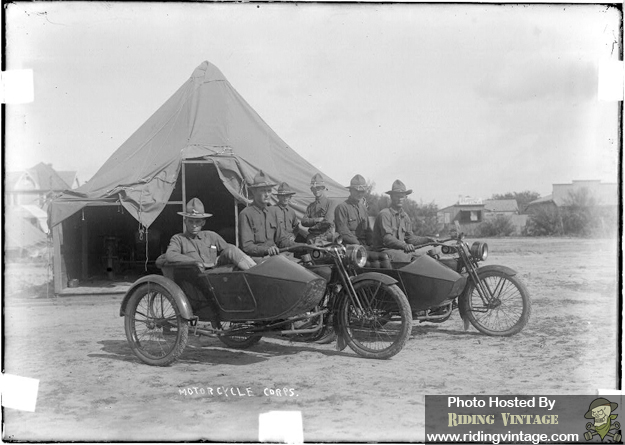


The May 1918 Robert Runyon Photo Set
Robert Runyon took this collection of photographs at Fort Brown in May 1918. His Brownsville-area photography is one reason these border-service images survive with such strong local context. They show the Army at the edge of a transition, with riders, sidecars, and gun-carriage equipment gathered at a post better known for cavalry and border duty than for mechanized warfare.


Motorcycle Training, Patrol Work, and Dispatch Duty
Fort Brown’s motorcycle troops were part of a practical border-service environment. The Rio Grande patrol mission required mobility, communication, and readiness. Motorcycles could carry dispatches between posts, move a rider quickly along usable roads, and support motorcycle training around the garrison. They were not a replacement for cavalry, but they gave cavalry-era units another tool.
The motorcycle machine-gun idea was especially attractive in the 1910s. A sidecar outfit could bring a crew-served weapon to a point faster than many older systems, then dismount or set up from the sidecar depending on the drill. That did not make the motorcycle a battlefield cure-all. Rough terrain, dust, tire trouble, fuel, maintenance, and limited payload all mattered. But in a border-post setting, where speed and communication were valuable, the motorcycle made sense. Home-front training used a similar arrangement, including a 1918 Police Reserve women’s Lewis-gun squad on an Excelsior sidecar.
The same post life also included the ordinary routines of a wartime garrison. YMCA-supported lectures, concerts, and other troop programs were part of Fort Brown life in 1918. Those details help place the motorcycle detachment in a real community rather than a purely mechanical story. These men were training and patrolling at a tense border post, but they were also part of a garrison that interacted with Brownsville and the wartime home-front support network.


Uniforms, Equipment, and What the Photos Show
There was no separate motorcycle branch uniform in this period. The men in these images belong to the World War I-era Army and cavalry world, with standard service clothing adapted to motorcycle use. Khaki uniforms, leggings, leather jackets or chaps in some cases, gloves, goggles, and practical riding gear fit the period far better than any specialized motorcycle helmet or badge.
That mix is one of the best parts of the photo set. The motorcycles are modern for 1918, but the men and the post still belong to the old Army. Crossed-saber cavalry identity, campaign-era clothing, sidecar gun hardware, and Harley-Davidson twins all sit together in the same images. The result is not yet the fully mechanized Army of World War II. It is the in-between stage, when a horse-cavalry institution was testing the tools that would eventually change how the Army moved.
The armored gun carriages also deserve attention. A sidecar-mounted shield could give the crew a measure of protection and a more stable platform for a mounted gun. The concept looked promising in photographs and demonstrations, especially on roads and open ground. In real field use, the limits would have been obvious, but the experiment foreshadowed the Army’s continuing search for faster, lighter mobile firepower.


Legacy of the Fort Brown Motorcycle Corps
The Fort Brown Motorcycle Corps was not a permanent separate branch of the U.S. Army. It was part of the Army’s broader 1910s experimentation with motorcycles, sidecars, machine-gun carriers, and rapid dispatch work. By the time the border crisis quieted and the Army demobilized after World War I, many of these early motorcycle detachments were reorganized, absorbed, or simply disappeared from daily reporting.
Still, the idea did not disappear. Military motorcycles would remain useful for dispatch riders, military police, escort work, reconnaissance, and base operations for decades. By World War II, Harley-Davidson WLAs and other military motorcycles were familiar machines in U.S. service. The Fort Brown images show an earlier stage of that story: big Harley twins, sidecars, and soldiers on the Texas border while the Army was still deciding what motorized two- and three-wheelers could do.


These May 1918 Robert Runyon photographs are a small but important record of U.S. Army motorcycle experimentation at a border post shaped by the Mexican Revolution, World War I, and the last years of cavalry-centered military thinking.