WWII Motorcycle Training: Harley-Davidson WLA Riders in the 1940s
Depending on the source and the counting method, the number of motorcycles produced by Harley-Davidson during WWII can range from about 50,000 to much higher totals once the Harley-Davidson WLA, WLC, and other military-contract machines are grouped together. Regardless of the exact number, the U.S. military had to train thousands of soldiers on the operation and maintenance of these motorcycles. Harley-Davidson stepped up and provided mechanical training at its Service Schools, but the job of teaching soldiers to ride was left to the U.S. military.

Military bases across the United States provided different types of motorcycle training as terrain, equipment, and local unit needs allowed. Fort Knox, Fort Riley, Camp Carson, Fort Ord, and the large prewar maneuvers all show up in period photographs, and the common thread is clear: the Army was trying to turn motorcycles into practical tools for dispatch work, reconnaissance, maintenance, convoy control, and armored-unit support.
Training Soldiers for Motorcycle Duty
Army motorcycle training was not simply a matter of handing a soldier a Harley and sending him down the road. Period War Department manuals treated motorcycle use as a mix of operation, driver qualification, field care, and maintenance. Riders had to know how to start, stop, maneuver, service, and recover the machine under conditions that were far different from normal civilian riding.
The Camp Carson photograph above captures one of the more dramatic parts of that training. The motorcycle is being used as cover during a field exercise, which is a long way from the polished parade-line image many people have of wartime Harleys. Photos like this are useful because they show the kinds of situations instructors were preparing riders to face: dirt, dust, dismounted movement, weapons, and fast decisions made around a hot, heavy motorcycle.
Dispatch Riders, Convoys, and Message Work

The dispatch rider was one of the most important military motorcycle jobs. Radios improved quickly during the war, but written messages, hand-carried orders, and short-range liaison work still mattered, especially during maneuvers and in armored or mechanized units. A motorcycle could move quickly between headquarters, scout cars, command cars, and unit positions without requiring a full truck or jeep. Dispatch work also depended on maps, road signs, and terrain, especially when routes crossed unfamiliar or damaged country.
This Tennessee maneuvers photograph is a perfect example. The rider is not posing with the machine as a piece of equipment; he is using it as a messenger would use it, handing off information to a command vehicle while the larger unit is on the move. The same mix of messenger and escort duty helps explain why Harley-Davidsons also appear in wartime military police motorcycle work.

Motorcycle training also had a defensive side. Riders could be scouts, messengers, or members of armored and mechanized units, but they still had to understand what to do when the motorcycle stopped being transportation and the rider became a soldier on the ground. The Fort Knox photograph above shows an Armored Division motorcyclist dropping off the machine and taking up a defensive position.
That detail matters because motorcycles were not armored combat vehicles. They were fast, useful, and mechanically simple compared with larger vehicles, but they were also exposed. Training had to balance mobility with survival, and wartime photographs often show riders working around the motorcycle rather than fighting from it. The same field conditions explain why some exhausted motorcycle troops were photographed sleeping directly on their machines whenever a halt allowed it.
Maintenance Was Part of the Job

One reason motorcycle training had to include maintenance is that a broken motorcycle was useless to a dispatch rider. Harley-Davidson Service Schools helped with deeper mechanical instruction, but soldiers still had to handle routine care in the field. Oil, tires, chains, controls, ignition, carburetion, and general adjustments were all part of keeping a motorcycle useful in military service.
War Department motorcycle manuals divided the subject between operation and maintenance, which is exactly the combination shown in these photos. A rider did not need to be a factory mechanic to carry messages or scout roads, but he did need enough practical knowledge to keep the machine running and recognize small problems before they became large ones.
Fort Riley and Mechanized Cavalry Training

Fort Riley shows up in this set through mechanized cavalry and scout-car work. The motorcycle messenger in the photo above is delivering to a moving M3A1 Scout Car, which is the kind of job that made motorcycles useful in a mechanized unit. The rider had to know where the vehicle was going, how to approach it safely, and how to pass along a message without slowing the operation more than necessary.

The next Fort Riley image shows an armed motorcyclist serving as a messenger for his mechanized cavalry reconnaissance platoon. That does not mean every motorcycle became a front-line assault machine. It means the rider and the motorcycle were folded into the practical communication system of a unit that relied on movement, observation, and fast reporting.
Fort Knox and Armored Force Training

Fort Knox appears repeatedly in wartime motorcycle training photographs, especially in connection with armored units. The 1st Armored Division formation shown here was photographed for press coverage in March 1941, before the United States entered the war. It shows how motorcycles were already being presented as part of the modern armored force.

The 13th Armored Regiment motorcycle scout photograph gives the same idea at a more individual level. A motorcycle platoon could support reconnaissance, message carrying, and movement control, but the value of the machine depended on training. A rider had to manage the motorcycle, read the situation around him, and operate as part of a larger unit rather than as a lone civilian motorcyclist.
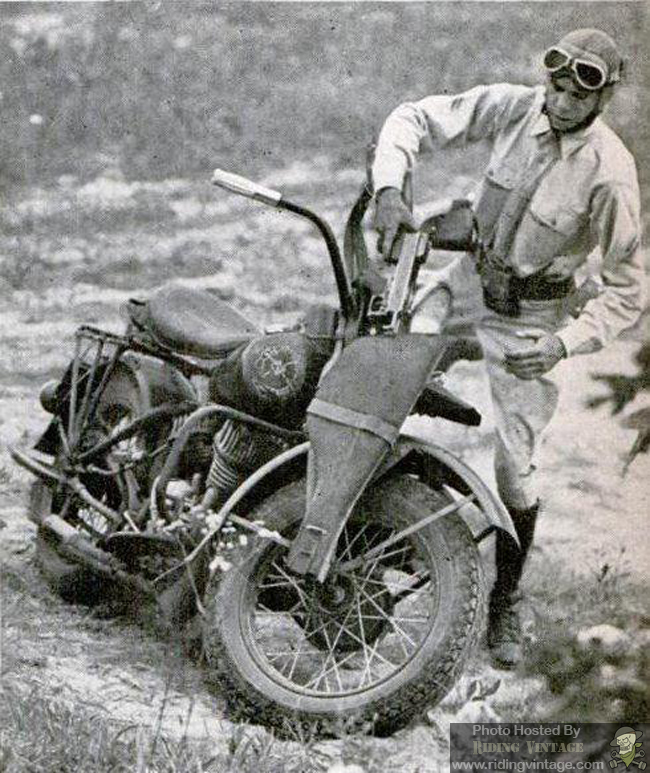
The Thompson SMG photograph from Popular Science is one of the best-known types of wartime motorcycle images because it is dramatic. It also needs to be read carefully. The presence of a Thompson scabbard on a WLA does not turn the motorcycle into a machine-gun platform. It shows that some military motorcycles carried weapons or weapon cases as part of their field equipment, which is a different subject from true wartime armed-motorcycle experimentation.

This Fort Knox maintenance photograph brings the article back to the routine side of military motorcycle training. The WLA and other Army motorcycles needed regular attention, and the Army had to train enough riders and mechanics to keep them working. That practical maintenance burden is one reason mechanical instruction and rider instruction were so closely tied together during the war.
The Motorcycles Used in Training

The Harley-Davidson WLA is the motorcycle most often associated with U.S. Army use in WWII, and the Fort Ord photo above shows WLA models in front of other military vehicles. Indian motorcycles and other machines also served in military roles. Experimental designs such as the Indian 841 went through Army testing, but the WLA became the best-known American example because of its numbers, its military equipment, and its survival after the war.
Typical military equipment could include olive-drab finish, blackout lighting, leg shields, skid plates, luggage racks, ammo boxes, oil-bath air cleaners, and weapon scabbards, depending on model, contract, and unit use. Those details matter here because they explain why training covered more than basic riding. Soldiers were learning to operate a loaded military motorcycle in the same environment as command cars, scout cars, jeeps, and armored vehicles.