Australian Harley WLA Dispatch Riders in WWII and Korea
Before the United States entered WWII, American-built motorcycles were already moving into Allied service through Lend-Lease. The wartime Harley-Davidson WLA became one of the best-known of those machines, with more than 30,000 Allied-export WLAs going to nations including the Soviet Union, China, France, and Britain.

Australia received WLAs through that wartime supply system as a British Commonwealth nation. The exact unit-by-unit accounting is still uneven, but surviving records and later summaries generally put the Australian total near 4,000 to 4,500 machines, often rounded to about 4,200. That was a small share of overall WLA production, but a large enough number to make the Harley a familiar Australian Army motorcycle in WWII and after.
Lend-Lease Harleys in Australian Service
The WLA was not a civilian WL with olive paint. The standard 42WLA was a 45 cubic-inch, 738 cc side-valve V-twin with a three-speed hand-shift transmission, foot clutch, oil-bath air cleaner, blackout lighting, front bumper, luggage equipment, and a right-side fork bracket for a submachine-gun scabbard. At roughly 540 pounds empty, it was heavier than many British dispatch motorcycles, but it carried gear well and was built for hard military use.
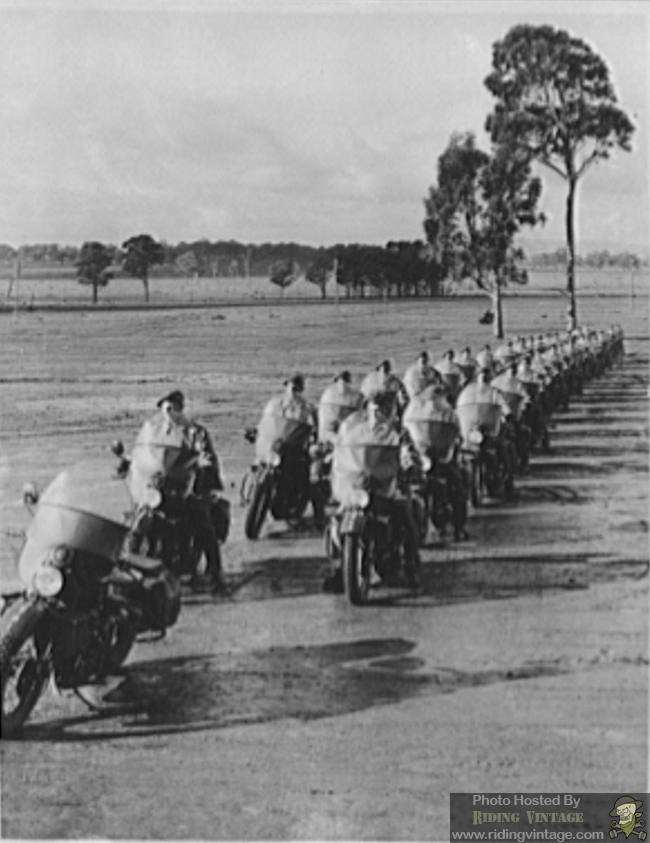
Australian WLAs were used much the same way American WLAs were used: as dispatch, liaison, staff, and traffic-control motorcycles. Signals units needed riders who could carry messages when telephone lines, radios, or roads were unreliable. Provost and Military Police units also used motorcycles for escort, road control, and base traffic duties, the same general pattern seen in broader military police motorcycle duties during the war.
The Middle East and North Africa were natural places for the WLA to appear in Australian hands. The desert was hard on machinery, but the Harley’s oil-bath air cleaner, simple side-valve engine, and stout frame made sense for dusty roads, convoy routes, and rear-area communication work. Australian dispatch riders were commended for their work in those Middle Eastern campaigns, where quick communication between headquarters, convoys, and forward units could matter as much as the motorcycle itself. Australian forces also used British machines such as BSA and Norton singles, but the WLA gave riders a larger, heavier motorcycle with good load capacity and a reputation for durability.
Postwar WLAs and the Road to Korea
When WWII ended, Allied equipment did not neatly return to the United States in the way Lend-Lease paperwork might suggest. Some machines were retained by armies, some were sold as surplus, some were scrapped, and some simply disappeared into storage, local disposal, or civilian use. In Japan, U.S. military Harleys were rebuilt for continued postwar service. In Holland, related Canadian WLCs were adapted for roadside-assistance and public-service work. That uneven postwar fate is probably where many of the old stories began about fields full of WLAs, piles of surplus motorcycles at military bases, and brand-new crated Harleys being dumped or destroyed. Those stories are best treated as surplus legends unless a specific shipment or disposal record can be tied to the claim.

Australia kept enough WWII-era WLAs in service that the Harley was still around when the Korean War began in 1950. By then the bikes were aging military stock, not new equipment, but they were still useful dispatch machines. The same basic qualities that made the WLA valuable in WWII — load capacity, ruggedness, and simple mechanical layout — still mattered on Korean roads and tracks.
3RAR Dispatch Riders in Korea
The Korean War photographs show the old 45s still doing real work. Private Jack Clark, a dispatch rider with the 3rd Battalion, Royal Australian Regiment, is shown sitting on a WLA somewhere in Korea. The image connects the WWII Lend-Lease motorcycle story directly to the postwar Australian Army, where surviving WLAs stayed in use long after their first wartime service.

Another 3RAR dispatch rider is shown working on his WLA while parked in front of a Korean home. That kind of field adjustment was part of dispatch-rider life. A motorcycle could get through where larger vehicles were slow or exposed, but the rider also had to keep the machine running, often with limited tools, limited parts, and no workshop nearby.

Private Bob Parker and Kapyong
Private Robert “Bob” Parker, also of the 3rd Battalion, Royal Australian Regiment, was an experienced motorcyclist before the war and had ridden off-road scrambles in Australia. In Korea he served as the battalion commanding officer’s dispatch rider, using a WLA for the kind of fast, exposed liaison work that had always made dispatch riding dangerous.

During the Battle of Kapyong in April 1951, Parker was shot in the hip while riding alone on his WLA. He lost control and crashed into a ditch. In the confusion of the withdrawal and fighting around him, American and Australian troops unknowingly left him behind.
Parker managed to crawl to a peasant’s hut. From there, he reportedly fired on some of the advancing Chinese troops before he was eventually forced to surrender. He was captured and spent more than two years as a prisoner of war under harsh conditions. Parker was finally released in August 1953 and returned home to Australia.
Surplus, Survivors, and the WLA Legend
The WLA remained in Australian service well past its original wartime moment, but time, parts supply, and newer motorcycles eventually caught up with it. By the 1960s, obsolete American motorcycle parts were harder to support, and lighter British machines such as the BSA B40, introduced into Australian service around 1967, helped replace the old Harleys. Remaining Army WLAs were sold through late-1960s auctions, scrapped, restored, or absorbed into civilian hands.
That postwar afterlife is part of why Australian WLA history is difficult to pin down neatly. Official records do not always list individual motorcycles, unit allocations, or final disposal. What survives best are the photographs, veteran accounts, museum machines, and the bikes that passed into the hands of collectors. Together they show that the Harley WLA was more than an American WWII icon. In Australian service, it bridged Lend-Lease, the Middle East, postwar Army stock, Korea, and the hard life of the dispatch riders who depended on it.